
A practical, field-tested housekeeping plan for warehouses, distribution centers, and fulfillment facilities in Bolingbrook, IL. Organized so nothing slips through the cracks.
A warehouse is one of the toughest spaces to keep clean. Forklift traffic, dust settling on inventory, grease at the docks, spills that turn into slip hazards in seconds, and square footage measured in the tens of thousands. In a space like that, we’ll clean it when it looks dirty isn’t a plan; it’s how injuries, failed audits, and damaged product happen.
This checklist turns warehouse cleaning into a scheduled, documented, and accountable system. Use it as-is, or adjust the frequencies to match your facility’s traffic and volume. Everything below is organized two ways, by frequency (so your crew knows what to do today) and by zone (so nothing physical gets missed).
Before the task lists, it helps to understand why each item matters. This is what separates a real program from sweeping now and then:
Keep this in mind as you build your program: frequency should follow how the building is actually used – not habit.
These are the non-negotiables – done every operating day, usually across shifts.
☐ Police all aisles and pedestrian lanes – clear debris, banding, shrink wrap, stretch film, and pallet fragments.
☐ Respond to spills immediately – use proper absorbents and place wet-floor signage before cleanup.
☐ Sweep or dust-mop main entries, time-clock areas, and high-traffic walkways.
☐ Service all employee areas – restrooms restocked and sanitized, breakroom wiped down, locker areas tidied, offices cleaned.
☐ Empty trash at workstations and service all dock waste points.
☐ Police dock plates, levelers, and the dock apron for debris and trip hazards.
☐ Wipe shared touchpoints – scanners, radios, time clocks, door handles, breakroom surfaces.
☐ Spot-check for leaks under equipment, charging areas, and hydraulic points; flag anything new to maintenance.
Why daily matters: most warehouse incidents trace back to something that was going to get cleaned up. Daily policing is the cheapest insurance you’ll ever buy.
☐ Auto-scrub main travel lanes, staging areas, and shipping/receiving floors.
☐ Sweep dock exteriors and aprons; spot-degrease oil and hydraulic drips at trailer positions.
☐ Dust accessible surfaces in offices, control rooms, and QA stations; clean interior glass and partitions.
☐ Clean and sanitize drinking fountains, vending areas, and microwaves.
☐ Detail restrooms beyond the daily service – fixtures, partitions, floors, and grout lines.
☐ Wipe down charging stations and check for residue/corrosion (exterior only, per your safety rules).
☐ Empty and clean recycling, cardboard, and baler areas.
☐ Full-floor auto-scrub, including under-rack edges where it’s safe to reach.
☐ Low-level rack and beam dusting (reachable levels only – anything higher is scheduled project work).
☐ Wash down dumpster, compactor, and trash-enclosure areas; deodorize as needed.
☐ Machine-scrub breakroom and restroom floors; descale fixtures and remove hard-water buildup.
☐ Clean dock doors, tracks, seals, and vision panels.
☐ Dust and clean HVAC vents, fans, and accessible ductwork exteriors.
☐ Inspect and clean floor drains to prevent odor and backup.
☐ Clean light fixtures at reachable heights – dusty lenses noticeably cut your lighting levels.
These are planned projects – scheduled with operations, using proper lifts and trained crews, with product protected or moved as needed.
☐ High dusting of beams, joists, light fixtures, sprinkler heads, and upper racking.
☐ Pressure wash dock exteriors, truck courts, and entry aprons (hot water for grease; follow local wash-water rules).
☐ Deep-clean and inspect pedestrian lane markings; schedule repainting where they’ve faded.
☐ Deep-clean office areas – carpet extraction and hard-floor refinishing (strip & wax / burnish as applicable).
☐ Clean skylights, clerestory glass, and exterior office windows where accessible.
☐ Strip and refinish VCT, or re-polish/burnish concrete in office and high-visibility zones (usually every 12–24 months).
☐ Clear dust from sprinkler heads and fire-safety clearances (buildup can affect response).
☐ Full facility deep clean – ideally during an annual shutdown or your slow season.
Combustible dust warning: Facilities that generate combustible dust (wood, flour, metal, plastics, and similar) have extra, legally required housekeeping duties under NFPA standards and OSHA guidance. Those programs have to be built around your specific hazard analysis – don’t rely on a general checklist for them.
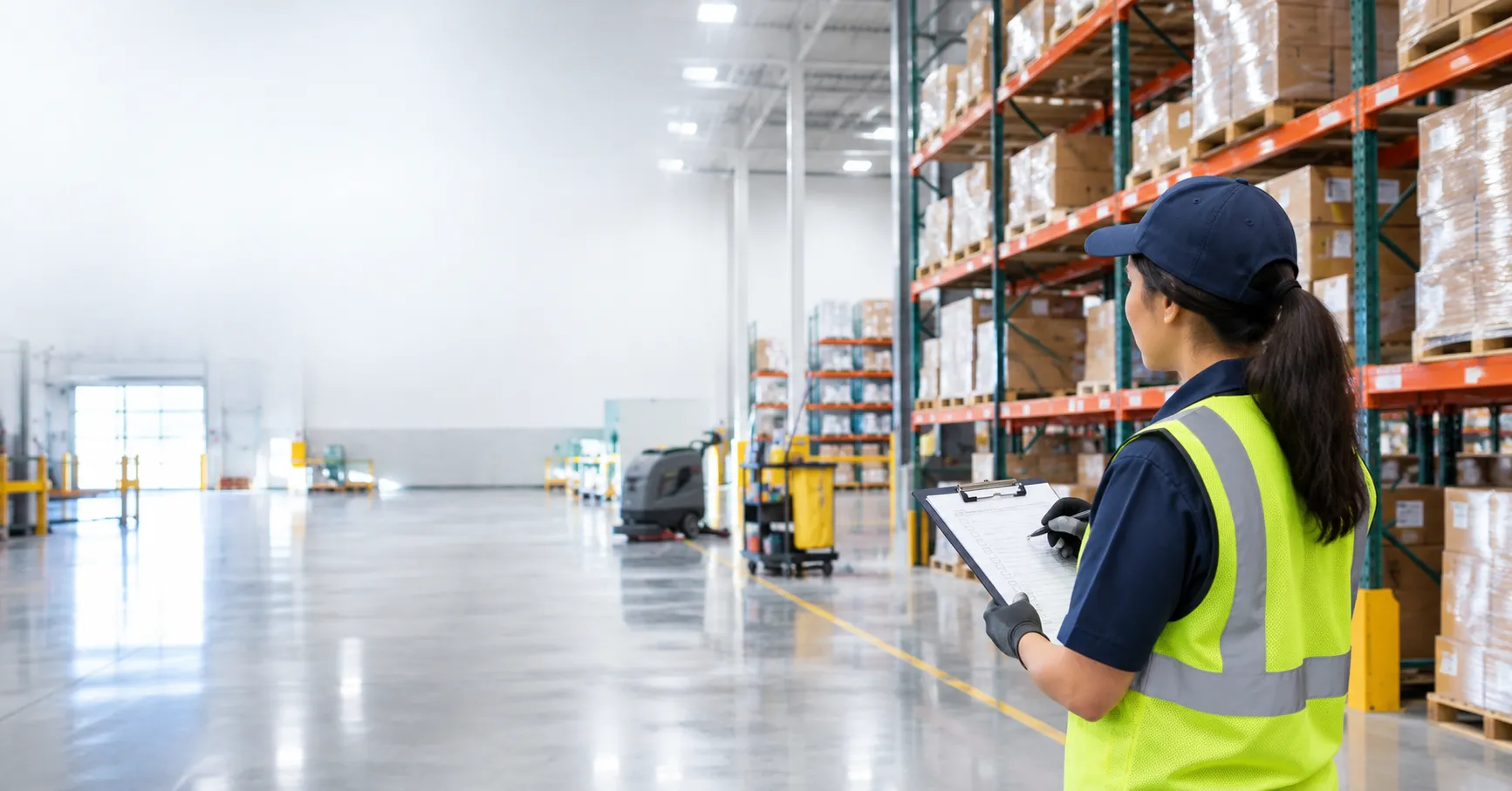
Frequency tells your crew when. Zones make sure nothing gets forgotten. Walk the building this way:
Zone | Key tasks | Typical frequency |
Receiving / inbound docks | Police plates & levelers, sweep apron, degrease trailer positions | Daily–Weekly |
Storage/racking | Aisle policing, floor scrub, low & high rack dusting | Daily–Quarterly |
Pick/pack/fulfillment | Debris control, floor scrub, touchpoint sanitizing | Daily–Weekly |
Shipping / outbound docks | Floor scrub, door/track cleaning, waste service | Daily–Monthly |
Battery/charging areas | Exterior wipe-down, leak/residue inspection | Weekly |
Breakrooms & restrooms | Full sanitation, floor scrub, descaling | Daily–Monthly |
Offices & control rooms | Dusting, glass, carpet/hard-floor care | Daily–Quarterly |
Exterior & truck court | Sweep, pressure wash, dumpster area | Weekly–Quarterly |
Overhead (beams, lights, HVAC) | High dusting, fixture cleaning | Quarterly–Annual |
The best plan falls apart without the right tools on hand. Keep these stocked and maintained:
Pro tip: Match the chemical to the surface. The wrong pH damages floor finishes, voids warranties, and leaves haze. Neutral cleaner is the default; specialty products only where they’re actually needed.
This is where most warehouse programs quietly fall apart – and where a good one really stands out.
Give every task an owner. Each item above should have a named owner (shift lead, janitorial crew, or contractor) and someone who verifies it. Everyone’s job has a way of becoming no one’s job.
Document completion. Use a simple sign-off log – paper or digital – recording what was done, when, and by whom. In an audit, that record is part of the deliverable. If it isn’t documented, to an inspector it didn’t happen.
Review on a trigger, not just a calendar. Re-scope the program whenever operations change – new lines, added shifts, seasonal volume spikes (peak and holiday fulfillment), or new product types all shift the cleaning load.
Keep an audit trail for:
OSHA’s Walking-Working Surfaces standard (29 CFR 1910.22) requires that workplaces be kept clean, orderly, and sanitary, that floors be kept dry where feasible, and that aisles and walkways stay clear. Housekeeping citations are some of the easiest for an inspector to write – because the evidence is visible from the aisle.
A scheduled cleaning program with documented completion turns housekeeping from a daily judgment call into a controlled, defensible process – exactly what auditors, insurers, and quality systems want to see. For combustible-dust facilities, additional NFPA requirements apply (see the warning above).
This section is general guidance, not legal advice – confirm your specific obligations with a qualified safety professional.
Main travel lanes usually need weekly scrubbing in active facilities, with a monthly full-floor pass. High-throughput operations with heavy forklift traffic often scrub main lanes several times a week.
It should be planned work – scheduled with operations, using proper lifts and trained people, with product protected or moved. It’s a periodic project, not something squeezed in between shifts.
Yes. Settled dust transfers to product and packaging – a real issue for food-grade and consumer goods – and speeds up wear on conveyors and equipment. Dust control is inventory protection.
Employee areas, absolutely. But warehouse floor programs, dock degreasing, and high dusting usually need specialized equipment (ride-on scrubbers, lifts, hot-water pressure washers) and trained crews. Many facilities split the two.
Tier the work: clean support spaces during production, run floor scrubbing on off-shifts or planned downtime, and schedule high-level project work for shutdown windows. The schedule follows the operation – not the other way around.
Nissi Cleaning Service builds scheduled, documented warehouse housekeeping programs for facilities across Bolingbrook, IL, and the surrounding area – from daily dock policing to annual high dusting, with the trained crews, the right equipment, and the completion records that keep you audit-ready. We’re locally owned, fully insured, and background-checked, and the quote we give you is the price you pay.
Call (779) 212-4534 or Get a Free Quote