Most offices don’t have a cleaning problem. They have a consistency problem. Trash gets emptied, someone wipes the counter, and the space looks fine on the surface, but without a written system, certain tasks quietly get skipped week after week until they show up as a visible problem: dull carpet, a break room that never quite smells right, a reception desk that looks tidy but hasn’t actually been disinfected in days.
An office cleaning checklist fixes that by turning cleaning from a reactive habit into a defined system – what gets done, how often, and who’s responsible for it. Below is a full daily, weekly, and monthly breakdown, along with a few considerations specific to running an office in the Bolingbrook area.
There’s a real difference between we clean the office and we follow an office cleaning checklist. The first is reactive: someone notices a problem and fixes it. The second is structured: tasks are scheduled by frequency before they become visible problems in the first place.
A written checklist also creates accountability. When tasks are assigned and tracked, it’s easy to see what’s been done and what’s been missed. Without one, cleaning quality tends to drift, some areas get attention only when a client visit or inspection is coming up, and by then it’s a scramble rather than routine maintenance.
Bolingbrook is also a mixed office-and-logistics community, with a number of businesses located in shared office parks and multi-tenant buildings along the I-55 and Route 53 corridors. Shared lobbies, elevators, and parking structures mean more people passing through common areas before anyone reaches an individual suite, which is worth factoring into how often high-touch surfaces get attention, even if your own office is small.
Daily tasks are the foundation of any office cleaning checklist. These are the items that most directly affect hygiene and first impressions, and they’re the ones most likely to cause problems if skipped for even a few days.
On disinfection: most disinfectant products require a specific contact time, often several minutes, to actually kill the pathogens they’re rated for, not just the moment it takes to wipe a surface dry. Following the dwell time listed on the product label is part of what separates genuine disinfection from a surface that’s simply been wiped down.
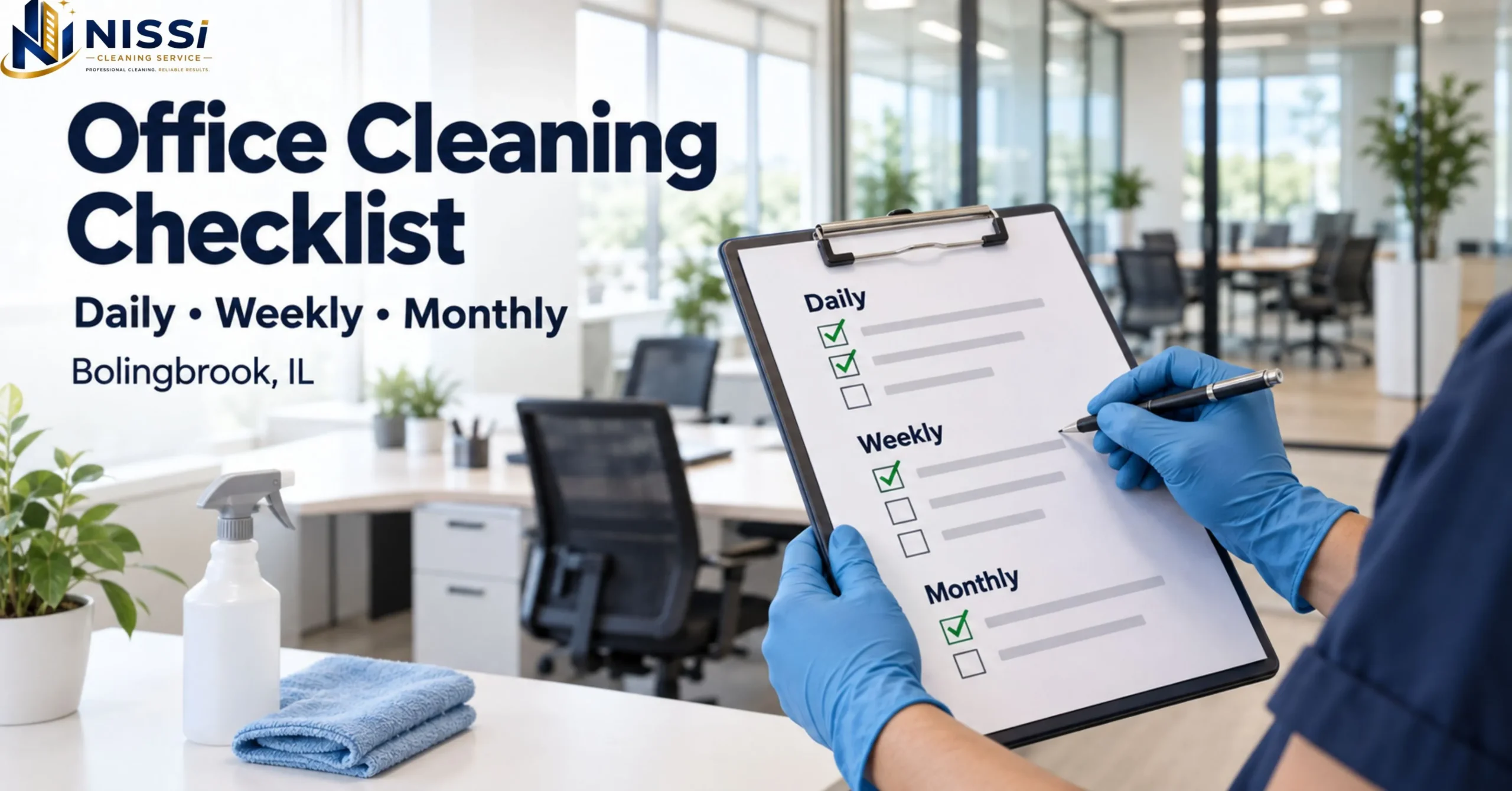
Weekly tasks address buildup that daily cleaning doesn’t reach, areas that don’t look obviously dirty day to day but accumulate dust, grime, and wear if left unattended for too long.
Monthly tasks cover deeper maintenance that’s easy to let slip because the effects build up gradually rather than all at once.
Illinois’ seasonal shifts affect office maintenance in ways that a generic, non-regional checklist won’t account for.
In winter, road salt and slush get tracked in on footwear, and that grit can work its way into entryway carpet if it isn’t addressed regularly – this is one area where offices near higher-traffic corridors may need more frequent attention from late fall through early spring than the rest of the year.
In summer, air conditioning systems run for extended periods, and HVAC drip pans and vents can accumulate condensation. That doesn’t automatically cause mold, but poorly maintained systems in consistently humid conditions are a recognized contributing factor, which is why periodic HVAC vent inspection is worth including as a checklist item rather than assuming it will never be a problem.
Spring and fall bring pollen and additional dust through doors that open more often, which mainly affects how consistently entryway and reception areas need daily attention during those transition months.
Beyond the standard daily list, a handful of surfaces get touched constantly but are commonly left off cleaning routines entirely:
Including these explicitly in a written checklist – rather than assuming they’re covered by general cleaning- is one of the more reliable ways to close gaps that standard routines miss.
A checklist only works if it’s clear who is responsible for each task and whether it actually got done. Two approaches cover most offices:
Whichever method you use, the goal is the same: a checklist without a clear owner for each task tends to quietly stop being followed within a few weeks.
Many smaller offices manage daily tidying internally – a team member wipes down their own desk, someone restocks the coffee station. That can work fine for a small space with a handful of employees.
As an office grows in size, staff counts, or foot traffic, a few signs tend to indicate it’s worth evaluating professional cleaning services:
There’s no single square-footage or employee-count threshold that applies to every business, it depends on layout, industry, and how much daily traffic the space sees. A walkthrough with a commercial cleaning provider is generally the most reliable way to get an accurate sense of what a space actually needs and what it would cost to maintain.
It depends on office size, foot traffic, and industry. Most offices need daily attention to restrooms and high-touch surfaces, plus weekly and monthly deeper cleaning, a walkthrough is the best way to get a specific recommendation.
Trash removal, restroom sanitation, floor care, and surface disinfection are standard. Carpet extraction, window washing, and floor stripping are usually scheduled as separate add-on services.
Many small offices manage daily tidying in-house successfully. As staff count, space, or traffic increases, the time and consistency required often make professional service more practical – though the right point varies by business.
Time depends on square footage, layout, and scope of service, so it varies significantly between buildings. A cleaning provider can give an accurate estimate after seeing the space.
If your office needs a customized daily, weekly, and monthly cleaning schedule, Nissi Cleaning Service provides Commercial cleaning throughout Bolingbrook, IL, and the surrounding area. Contact us to talk through what your space needs.