
To choose a commercial cleaning company, confirm it carries insurance and screens its staff, check that it has cleaned buildings like yours, get a written scope of work after an in-person walkthrough, and compare quotes by what’s included rather than by the bottom-line number. Then read the contract before you sign.
Here’s a situation that plays out more often than it should. An office manager picks the lowest quote on a Friday afternoon because the budget is tight and the building needs cleaning. Three weeks later, the restrooms are stocked on some days and not others, the trash goes out on random nights, and nobody can say who exactly has the keys. (This is an illustrative scenario, not a specific client story.) The cleaning company wasn’t necessarily bad. Nobody had defined what “clean” meant before the work started.
That gap is what this guide closes. Below is how to choose a commercial cleaning company in seven steps, along with the documents to request, the red flags to watch for, and a plain explanation of pricing so the quotes you collect can actually be compared.
A commercial cleaning company provides recurring or one-time cleaning for non-residential spaces such as offices, clinics, schools, warehouses, and the shared areas of apartment communities. Routine work usually covers trash removal, restroom sanitizing, floor care, dusting, surface disinfection, and restocking supplies. Periodic work can include carpet extraction, floor stripping and waxing, or a one-time deep clean.
You’ll also see the word janitorial. It usually means the routine, scheduled maintenance part of the job, and many companies use the two terms interchangeably. What matters is what the contract lists, not what the service is called.
The work also changes a lot by building. A warehouse needs floor and dock-area attention. A dental office needs careful surface handling around patient spaces. A daycare has toys, nap areas, and changing stations. A company that’s excellent at one isn’t automatically set up for another, which is why Step 3 below matters.
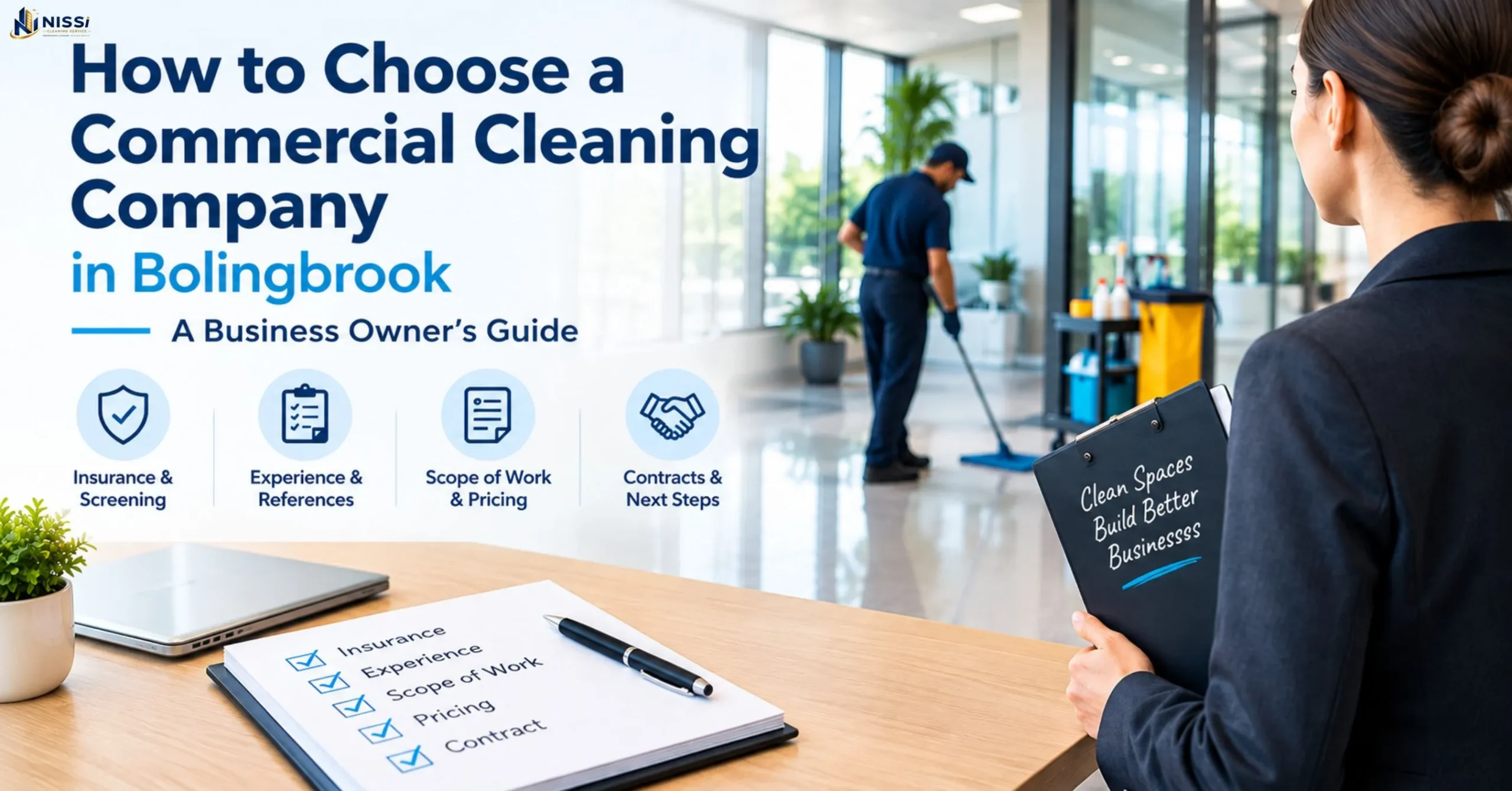
Work through these in order. Each step narrows your list, so by Step 6 you should be comparing two or three serious options instead of ten websites.
Before you call anyone, put a one-page list together. Include which rooms get cleaned, how often, what hours the building is empty, any surfaces that need special care, and anything with compliance weight such as a clinic exam room.
A simple version might read: restrooms nightly, breakroom nightly, floors vacuumed three times a week, glass doors weekly, carpets deep cleaned quarterly. That list is the most useful thing you’ll create in this process, because quotes only compare when every company prices the same scope. A quote for cleaning my office gets you five numbers that mean five different things.
This step comes early because it’s a pass/fail filter, not a preference. Cleaners often work after hours with access to keys, alarm codes, and offices, so what a company can show you matters more than what it says.
Ask for these:
In Illinois, employers are generally required to carry workers’ compensation coverage, so a company that can’t document it is a red flag. If a worker is hurt in your building, a coverage gap can become your problem too. Your own insurance broker or attorney can tell you exactly what your lease or policy requires.
A professional company won’t hesitate on any of this. Hesitation is information.
Ask which types of facilities they clean now, and ask for a reference from one similar to yours. A company that mostly cleans offices can still do a good job in a daycare, but you want to hear how the checklist changes. Good answers are specific: separate cloths and mops for restrooms versus other areas, how toys are handled, how they work around patient appointments.
If you want to see what facility-specific scope looks like on paper, compare how Nissi Cleaning describes its daycare cleaning, dental office cleaning, and warehouse cleaning services. The tasks, timing, and priorities are not the same.
When you call references, skip “Are you happy?” Ask: What did they get wrong, and how fast did they fix it? Would you hire them again at this size of contract? What happens when your usual cleaner is out?
Training and supervision are where cheap and reliable diverge. Ask who trains new cleaners, how long before someone works alone in a building, and who checks the work and how often.
Chemical handling is a good test question. Under OSHA’s Hazard Communication Standard, employers must make safety data sheets available for hazardous chemicals their workers use. A company that trains well can tell you where those sheets are kept and which products it uses on which surfaces.
Also ask about continuity: Will the same crew come each time? Who covers a sick day? Who is your named contact, and how do you report a missed task?
A company that quotes a commercial building by phone without seeing it is guessing. A walkthrough lets them measure the space, note floor types, count restrooms, and spot problems you forgot to mention.
The written scope that follows should list tasks by area, frequency, which supplies and consumables are included (paper, soap, liners), key and alarm procedures, and how the schedule can change. If a task isn’t written down, assume it isn’t included.
This is where how to choose a commercial cleaning company gets practical. Lay your quotes side by side and check what each one actually covers before looking at the totals.
There are three common pricing models:
Model | How it works | Watch for |
Per square foot | Rate tied to building size and task intensity | Whether high-traffic areas cost more |
Hourly | You pay for crew time | No cap on hours, unclear crew size |
Flat monthly | Fixed fee for a defined scope | Whether extras and holidays cost more |
Then ask each company the same questions: Are supplies included? Are deep cleans, holiday visits or extra restroom stops charged separately? Can the price rise mid-contract, and with what notice?
A much lower quote can reflect a smaller scope, less supervision, or higher staff turnover, though not always. The point isn’t that cheap is bad. It’s that a price without a matching scope tells you nothing.
Read the term length, cancellation notice, automatic renewal clause, rate increase language, and how complaints are handled. Ask how a satisfaction guarantee works in practice: do they return to re-clean, how quickly, and is there a charge?
Where you can, start with a short initial term or a one-time deep clean before committing to a recurring schedule. It lets you see the company’s actual work and communication before the contract gets long.
What you’re checking | Green flag | Red flag |
Insurance | Provides a current COI without being chased | Vague answers or an expired certificate |
Quote process | Walks your space before pricing | Prices by phone with no visit |
Scope | Written, by area and frequency | “We’ll take care of everything” |
Staff | Explains screening, training and coverage | Can’t say who will be in your building |
Communication | Names a contact and a response time | Contact is a general inbox |
Contract | Clear exit terms, short initial option | Long auto-renewal, hard cancellation |
References | Offers similar facilities | References only from friends or unrelated work |
It depends, and any company that gives you a firm price without seeing your space is estimating. Cost follows building size, facility type, cleaning frequency, the hours you need (after-hours or overnight work can change the price), floor types, how heavy the use is, and whether supplies are included.
A small daycare and a large warehouse are priced differently for good reason. The honest way to get a number is to give three companies the same written scope from Step 1 and the same walkthrough, then compare. Nissi Cleaning advertises free, no-obligation quotes. Contact the company to confirm the quote process, what the estimate includes, and whether any additional charges may apply. Use this wording unless the original pricing promise is current, accurate, and supported by clear terms
If a competing quote is far lower, ask what was left out before you decide anything.
It depends on what you value. A locally owned company may offer direct communication and convenient in-person visits, depending on its staffing and management structure. Ask how scheduling changes and urgent requests are handled. The trade-off is a smaller team, so ask how they cover absences. A national brand tends to bring standardized systems and more capacity, but you may deal with more layers, and in a franchise model, service quality can vary by location.
Whichever you lean toward, the Step 2 to Step 7 checks apply equally. Nissi Cleaning describes itself as locally owned and operated in Bolingbrook, which means that on its end the owner, schedule, and service area are all in one place.
These five show up again and again:
If you run a clinic, dental office, daycare, or school, cleaning isn’t only about appearance. Your own infection-control, licensing, or health policies may set requirements the cleaners need to follow. For medical and dental settings, OSHA’s bloodborne pathogens standard may apply to your workplace, so ask a prospective company which tasks its staff will and won’t perform, and how they’re trained for them. For childcare, check what your licensing body expects.
The practical move is to bring your compliance contact into the conversation early, and to ask each company how it works around appointments, classes, or nap times. That scheduling question alone separates specialists from generalists. Confirm your exact obligations with the relevant authority rather than relying on a vendor’s summary.
A good start looks like this:
If problems repeat after you’ve raised them in writing, that’s a pattern, not a bad week. Check your contract’s cancellation terms and decide whether to give formal notice.
If you remember one thing about how to choose a commercial cleaning company, make it this: define the work first, verify the paperwork second, and look at price third. Companies that welcome that order of operations tend to be the ones worth hiring.
If you’re in Bolingbrook or nearby and want to see how that process works with a local team, Nissi Cleaning offers a free, no-obligation quote after a walkthrough or a conversation about your space. You can call (779) 212-4534
Ask for a certificate of insurance, how staff is screened and trained, who supervises the work, what’s included in the written scope, how quotes are priced, and what the cancellation terms are. Also ask who covers when your regular cleaner is absent.
Insured means the company carries insurance, typically general liability and workers’ compensation, that responds if someone is hurt or property is damaged. Bonded usually means a bond is in place that can reimburse a client for losses such as employee theft. They’re different protections, so ask about both.
Many do, but it varies by company and contract. Cleaning equipment is usually supplied by the cleaner. Consumables like paper products, soap, and liners are sometimes billed separately, so confirm it in the written scope.
It depends on traffic, use, and type of space. High-use areas like restrooms and breakrooms are commonly cleaned daily, while carpets and windows are often done on a periodic schedule. A medical or childcare space may need a higher frequency than a low-traffic office.
It can be, but compare the full cost. In-house means wages, payroll costs, insurance, supplies, equipment, and coverage for sick days and vacations. Outsourcing bundles those into one fee, and you’ll still want a written scope either way.