
Picture a hypothetical January morning at a Bolingbrook center: road salt on the entry floor, a substitute who doesn’t know where the sanitizer lives, and families arriving in ten minutes. This is an invented scenario, not a real client. The fix isn’t heroics. It’s a written routine that anyone on the team can follow.
This daycare cleaning checklist is built for child care providers in Bolingbrook, Romeoville, Woodridge, Naperville, and Plainfield. It shows what to clean, how often, and by which method, and it separates national recommendations from Illinois licensing requirements. You’ll also find a print-ready daily routine, a full diapering procedure, and an outbreak cleanup plan.
A daycare cleaning checklist is a written schedule of cleaning, sanitizing, and disinfecting tasks, sorted by how often each one happens and who is responsible. It helps a program keep the same standard from one shift to the next, and it gives you something concrete to show licensing representatives.
The CDC and Head Start treat these as separate steps:
Every product label lists its own dilution, contact time (how long the surface must stay wet), rinse steps, and safety directions. Follow them exactly. Wipe a disinfectant away after three seconds, and you’ve mostly made the room smell like lemons. For details, see the CDC’s guidance on cleaning early care and education settings and Head Start’s guide to selecting and using cleaning, sanitizing, or disinfecting products.
Handwashing is the cheapest tool you own, but it still takes soap, running water, at least 20 seconds, and a towel to dry with.
Two kinds of guidance shape a cleaning routine, and they aren’t interchangeable.
Requirements come from your license. Since July 1, 2026, the Illinois Department of Early Childhood (IDEC) has been the lead agency for child care licensing, taking over from the Department of Children and Family Services (DCFS). IDEC representatives make annual unannounced visits to licensed programs, and families can search monitoring reports on the state’s Sunshine website. The rules moved with the agency: centers now fall under 23 Ill. Adm. Code Part 2008, day care homes under Part 2007, and group day care homes under Part 2009. IDEC’s licensure page lists them all.
Recommendations come from national sources such as the CDC, Head Start, and Caring for Our Children, the national health and safety standards. The frequencies in this article come from Head Start’s cleaning schedule, which is adapted from those standards. They are best practice, not Illinois law, unless noted.
Three Illinois examples show the difference. Under the former DCFS center rules, toys and indoor equipment in infant and toddler programs had to be cleaned and disinfected daily. A sick child’s space had to be within sight and hearing of an adult. Centers also had to report known or suspected communicable disease cases to local health authorities. Those rules have since transferred to IDEC, so verify the current wording.
Bolingbrook spans Will and DuPage counties, so your health department depends on your address: the Will County Health Department or the DuPage County Health Department.
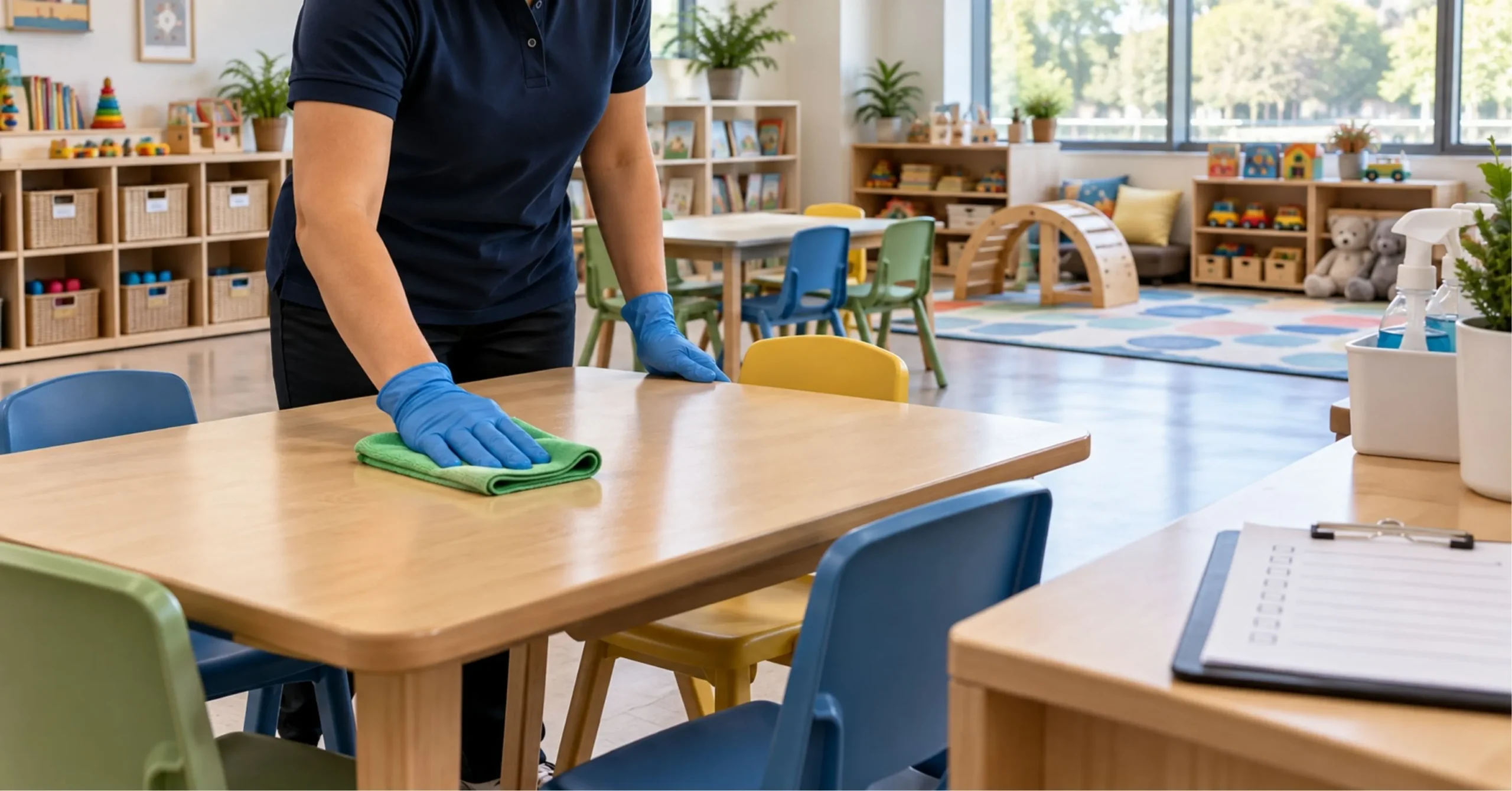
Unless noted, these are national recommendations, not Illinois requirements. Use microfiber cloths or disposable towels. Head Start advises against sponges and cotton mops in early childhood programs.
Area or item | Method | When |
Food prep surfaces and countertops | Clean, then sanitize | Before and after each use |
Dishes, utensils, bottle equipment | Clean, then sanitize | After each use (a dishwasher on its sanitize setting works) |
High chair trays and meal tables | Clean, then sanitize | Before and after each use |
Activity tables (no food) | Clean | After each use; sanitize if used for food, meals or tooth-brushing |
Mouthed toys | Clean; sanitize before another child uses them | Before and after each use |
Other classroom toys | Clean | Weekly and when soiled. Infant and toddler toys: see the former Illinois daily rule above |
Water tables and water toys | Clean, then disinfect | After each use: change the water, clean, then disinfect before a new group starts or at day’s end. Skip during outbreaks |
Changing tables | Clean, then disinfect | After every diaper change; let air dry |
Diaper pails, toilets, sinks, faucets, toileting-area counters and floors | Clean, then disinfect | Daily at day’s end; toilets also after use if soiled |
Potty chairs (if used) | Not listed in Head Start’s table | Follow your licensing rules and written procedure |
Drinking fountains | Clean, then disinfect | Daily |
Doorknobs, handles, light switches | Clean | Daily, and often through the day |
Floors and carpets | Clean | Floors and carpets daily; area rugs weekly; steam-clean carpets every 3 to 6 months |
Cribs, cots and mats (one child) | Clean; disinfect if soiled with body fluids | After each use and weekly |
Cribs, cots and mats (shared) | Clean; disinfect if soiled with body fluids | After each use by a different child |
Sheets, blankets, washable dress-up clothes, cloth toys | Launder | Weekly on the warmest setting the label allows, dried completely; sooner if soiled |
Copy this into your own document and post it in each room. It follows the frequencies above.
☐ Check bathrooms and restock soap, paper towels, toilet paper, and gloves
☐ Clean doorknobs, handles, and light switches
☐ Sweep or vacuum the entry and shake out or swap the mats
☐ Check ventilation: run the HVAC with outdoor air and filtration, or open windows and doors only when temperature, outdoor air quality, and window safety allow
☐ Confirm cleaning products are labeled, stocked, and locked away
☐ Wash hands of children and adults at arrival, before eating, after diapering or toileting, and after outdoor play
☐ Clean, then sanitize meal tables and high chair trays before and after eating
☐ Clean, then disinfect the changing table after every diaper change
☐ Move mouthed toys to a used bin, then clean and sanitize them before another child gets them
☐ Clean, then disinfect water tables after each use
☐ Clean up spills as they happen
☐ Clean, then disinfect toilets, sinks, faucets, counters, and floors in toileting areas
☐ Empty, clean and disinfect diaper pails
☐ Clean, then disinfect drinking fountains
☐ Vacuum carpets and clean floors
☐ Clean counters, shelves and activity centers
☐ Wash dishes; clean, then sanitize food prep surfaces
☐ Start laundry; initial and sign the log
These steps are adapted from the standard procedure in Caring for Our Children. Check them against your licensing rules and your program’s written procedure.
Locals joke that Illinois has two seasons: winter and road construction. Both leave marks on your floors.
Salt and slush turn entryways into sandpaper. Add entry mats and a boot tray, and mop the vestibule after slushy arrivals. With windows mostly shut, rely on your HVAC’s outdoor-air setting and good filters, or a portable air cleaner. Open a window or door only when temperature, wind, outdoor air quality and window safety allow. Never do it where it creates a fall, draft or cold-exposure risk for children.
Pollen and mud arrive together. Deep-clean outdoor toys and equipment, replace HVAC filters on the manufacturer’s schedule, and check whether carpets are due for their three-to-six-month steam clean.
Clean and disinfect water tables and water toys after each use. Skip water play during an outbreak or for children with open cuts or sores. Cover sandboxes when they’re not in use to keep animals out.
The back-to-school germ exchange begins. Refresh handwashing routines, clean heating vents before the furnace starts, and wash blankets and cold-weather gear.
Weekly (Head Start recommendation): Launder sheets, blankets, washable dress-up clothes, and cloth toys. Clean classroom toys and area rugs. Clean cribs, cots, and mats used by one child.
Every three to six months (Head Start recommendation): Steam-clean carpets.
Monthly (program practice): The sources above don’t set these on a monthly schedule, so treat this as your own calendar. Dust vents, ceiling fans, and light fixtures. Check HVAC filters. Clean the refrigerator, freezer, and dishwasher food trap. Look for leaks, mold, and pests. Test smoke and carbon monoxide detectors per the manufacturer’s instructions. Retire cracked or broken toys.
When a child vomits or has diarrhea, the goal is to protect the child, contain the mess, and protect everyone else.
A log doesn’t prove a task was done well, and a missing log doesn’t prove it wasn’t done. What a log does is give you and a licensing representative something concrete to review, and it shows patterns, like a task that keeps slipping on Fridays. Your daycare cleaning checklist can also double as a training tool for new hires and substitutes.
Keep it simple: task, date and time, initials, notes. Initial each task when you finish it rather than in one batch, assign tasks by role (opening, floor, closing), and review the sheets weekly. Retention requirements vary, so confirm the period with IDEC. Keep recent logs where you can reach them quickly, because visits are unannounced.
Child-safe isn’t a regulatory standard, so use specific criteria instead:
A professional cleaner extends your routine but doesn’t replace it. Deep cleans after long closures or outbreaks, carpet extraction, and high dusting are sensible uses. A deep clean before a licensing visit is good preparation, not a stated renewal requirement, and since visits are unannounced, your daily routine matters more.
Ask any company which EPA-registered products it uses, what background checks apply to staff working at your site, and whether it provides written service records.
Want help keeping up? Contact Nissi Cleaning Service at +1 (779) 212-4534 to ask about cleaning support for your Bolingbrook center or home daycare.
List each surface or item, the method (clean, sanitize or disinfect), how often, who is responsible, and a sign-off line. Cover diapering, toileting, meals, toys, sleep gear, floors, high-touch surfaces, and water play.
Clean mouthed toys before and after each use and sanitize before another child gets them. Head Start suggests weekly cleaning for other toys, but Illinois infant and toddler rules once required daily cleaning and disinfecting; verify current wording.
Sanitizing reduces germs to levels public health codes consider safe and suits food-contact surfaces and mouthed toys. Disinfecting uses an EPA-registered product to destroy or inactivate most germs on hard surfaces like changing tables. Clean first.
Retention requirements can vary, so confirm the exact period with IDEC or your licensing representative. Meanwhile, keep recent logs on site, organized, and easy to grab, because licensing visits are unannounced.
Wiping spills and routine cleaning with soap and water can happen while children are present. For sanitizers and disinfectants, follow the label’s ventilation and drying directions, and keep children in another space until surfaces are dry.
A routine only works if it’s written down, assigned and visible. Start with the table above, copy the daily routine into your own document, and adjust it to your rooms, staff and license type. Confirm any Illinois-specific requirement with IDEC, keep your daycare cleaning checklist where the whole team can see it, and revisit it whenever your program, your rules or the season changes.