
If you’ve been comparing quotes for your Bolingbrook business, you’ve probably run into two terms that get thrown around like they mean the same thing: janitorial services and commercial cleaning. They don’t.
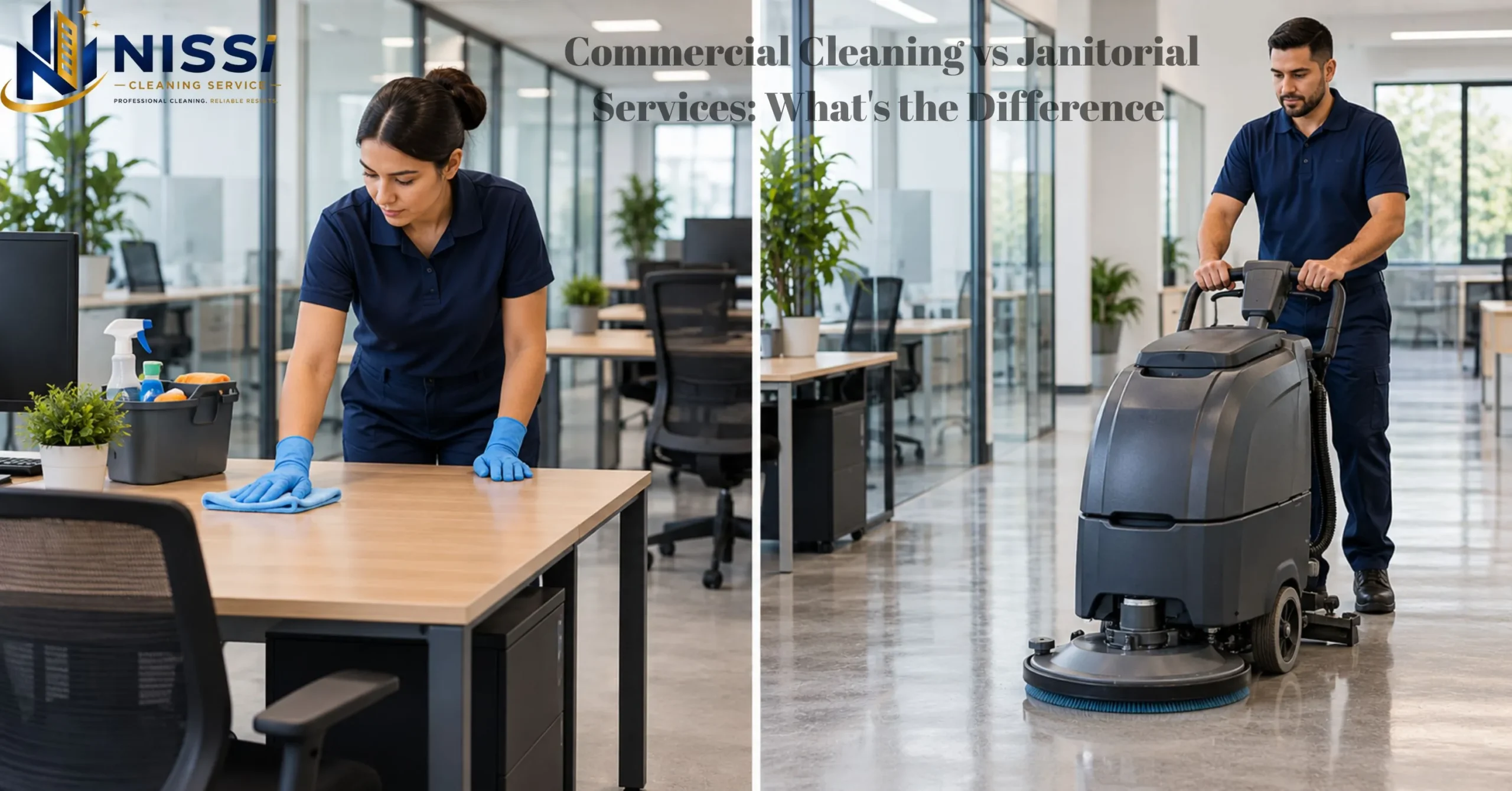
Janitorial services are the routine, everyday tasks that keep your space looking presentable: vacuuming, trash removal, wiping down surfaces. Commercial cleaning covers the deeper, less frequent work – carpet extraction, floor stripping and waxing, pressure washing, post-construction cleanup. One keeps your building tidy day to day. The other resets it.
Knowing the difference between commercial cleaning vs. janitorial services matters because it directly affects your budget, your cleaning schedule, and whether your space actually stays healthy, not just visually clean. Let’s break down what each one actually involves.
Janitorial services are the daily or weekly maintenance tasks that keep your office, retail store, or facility looking orderly between deeper cleans. Think of it as the upkeep layer.
A typical janitorial visit covers:
These tasks happen often, daily, a few times a week, or weekly, depending on foot traffic. A busy office with 40 employees needs a very different rhythm than a quiet two-person studio. Either way, janitorial work is about consistency. It’s the reason your lobby doesn’t look like a mess by Wednesday afternoon.
Commercial cleaning is the heavier, less frequent work that janitorial visits don’t touch. It’s scheduled monthly, quarterly, or seasonally, and it usually needs specialized equipment and trained technicians rather than a quick wipe-down.
Commercial cleaning typically includes:
This is the reset work. It removes the buildup, grime in grout lines, oil tracked into carpet fibers, salt residue baked into entryway tile, that daily wiping can’t touch. Because it’s more intensive, it’s often scheduled after hours or on weekends so it doesn’t disrupt your operations.
Factor | Janitorial Services | Commercial Cleaning |
Frequency | Daily, several times a week, or weekly | Monthly, quarterly, or as-needed |
Focus | Surface-level upkeep | Deep, specialized cleaning |
Typical tasks | Trash, vacuuming, dusting, restrooms | Carpet extraction, floor stripping, pressure washing |
Equipment | Basic tools, mops, vacuums | Industrial machines, extractors, buffers |
Scheduling | During or right after business hours | Often after hours or weekends |
Goal | Keep the space consistently presentable | Restore the space to a like-new condition |
Both matter. Skip janitorial work and your space looks neglected within days. Skip commercial cleaning and dirt builds up in places daily cleaning simply can’t reach; carpets, grout, and floor finishes wear out faster than they should.
Beyond the table above, a few practical differences tend to shape what a Bolingbrook business actually needs:
Janitorial cleaning stays on the surface. Commercial cleaning goes below it, into the fibers, the grout, the finish on your floors.
A janitorial crew carries a vacuum and a mop cart. A commercial cleaning team shows up with carpet extractors, floor buffers, and pressure washers, tools that need training to use properly and can damage surfaces in untrained hands.
Janitorial services are usually billed as a recurring contract, a flat rate per visit or per month. Commercial cleaning is often quoted per project, since the scope (square footage, floor type, level of buildup) varies more from job to job.
Some businesses keep an in-house janitorial staff and outsource commercial cleaning for the specialized work. Others, especially smaller offices, outsource both to one company, which is usually the more cost-effective route.
Here’s a simple way to think about it:
Most Bolingbrook businesses land in the same place: janitorial service keeps things running smoothly week to week, and commercial cleaning comes in on a set schedule to handle what daily cleaning can’t.
This isn’t just a national trend; it’s a local one. Chicago-area winters bring salt, slush, and mud straight through your front door for months at a time. Daily janitorial cleaning handles the surface mess: wiping down entryways, vacuuming tracked-in grit, emptying trash.
But salt residue works its way into carpet fibers and tile grout over a season, and that’s a job for commercial cleaning, carpet extraction and floor scrubbing that gets underneath what a mop can’t reach.
Combine that with Illinois’ allergy-heavy spring and dusty summer months, and most offices in and around Bolingbrook do better with a hybrid plan: routine janitorial upkeep paired with commercial cleaning every one to three months, adjusted around the seasons.
A few patterns show up again and again with facilities that call us after their first cleaning company didn’t work out:
Yes, and for most businesses, it’s the easier route. Instead of coordinating two vendors, one team manages your daily janitorial upkeep and your periodic deep cleans on a schedule built around your space, your traffic, and Bolingbrook’s seasons. That means fewer scheduling headaches, one point of contact, and a cleaning plan that actually adapts instead of treating every visit the same way.
The debate over commercial cleaning vs janitorial services isn’t really about picking a side, it’s about understanding that they solve different problems. Janitorial keeps your space looking good every day. Commercial cleaning keeps it actually clean underneath the surface. Most businesses need a mix of both, scaled to their traffic, industry, and the Bolingbrook seasons.
If you’re not sure where your business falls, Nissi Cleaning Service can walk your space and build a plan that covers both, so you’re not stuck choosing one over the other, or paying for more than you need.
Janitorial services handle daily upkeep like vacuuming and trash removal. Commercial cleaning handles deeper, less frequent work like carpet extraction and floor stripping.
Most businesses schedule commercial cleaning monthly to quarterly, depending on foot traffic, industry, and seasonal buildup.
Yes. Many providers, including Nissi Cleaning Service, offer both under a single contract for simpler scheduling.
Yes, but less often. A small, low-traffic office may only need commercial cleaning a few times a year.