A practical guide for Bolingbrook business owners and facility managers
The average office desk carries roughly 400 times more bacteria than a toilet seat, and almost none of it is visible. For a business, that invisible layer quietly shapes how often your team gets sick, how clients judge you in the first ten seconds, and how long your floors and furniture last before they need replacing.
Most businesses try to handle cleaning in-house or squeeze it into an employee’s day. It feels cheaper. In practice, it rarely is, once you count payroll, supplies, equipment, training, and the gaps that open up the moment someone calls in sick.
This guide breaks down the real benefits of hiring a commercial cleaning service, how it compares to cleaning in-house, which businesses gain the most, and the exact questions to ask before you sign with any company.
Before the benefits, it helps to know what’s included. A commercial cleaning service handles two kinds of work:
Routine janitorial work, daily or weekly upkeep: vacuuming, mopping, trash removal, restroom cleaning and restocking, break-room cleaning, dusting, and disinfecting high-touch surfaces like door handles, light switches, and shared equipment.
Periodic deep cleaning, scheduled less often: carpet extraction, floor stripping and waxing, high dusting, window cleaning, and post-construction or post-event cleanup.
The exact scope is set by a written agreement, so you know precisely which areas are covered, how often, and who is responsible for what. That clarity is the foundation every benefit below is built on.
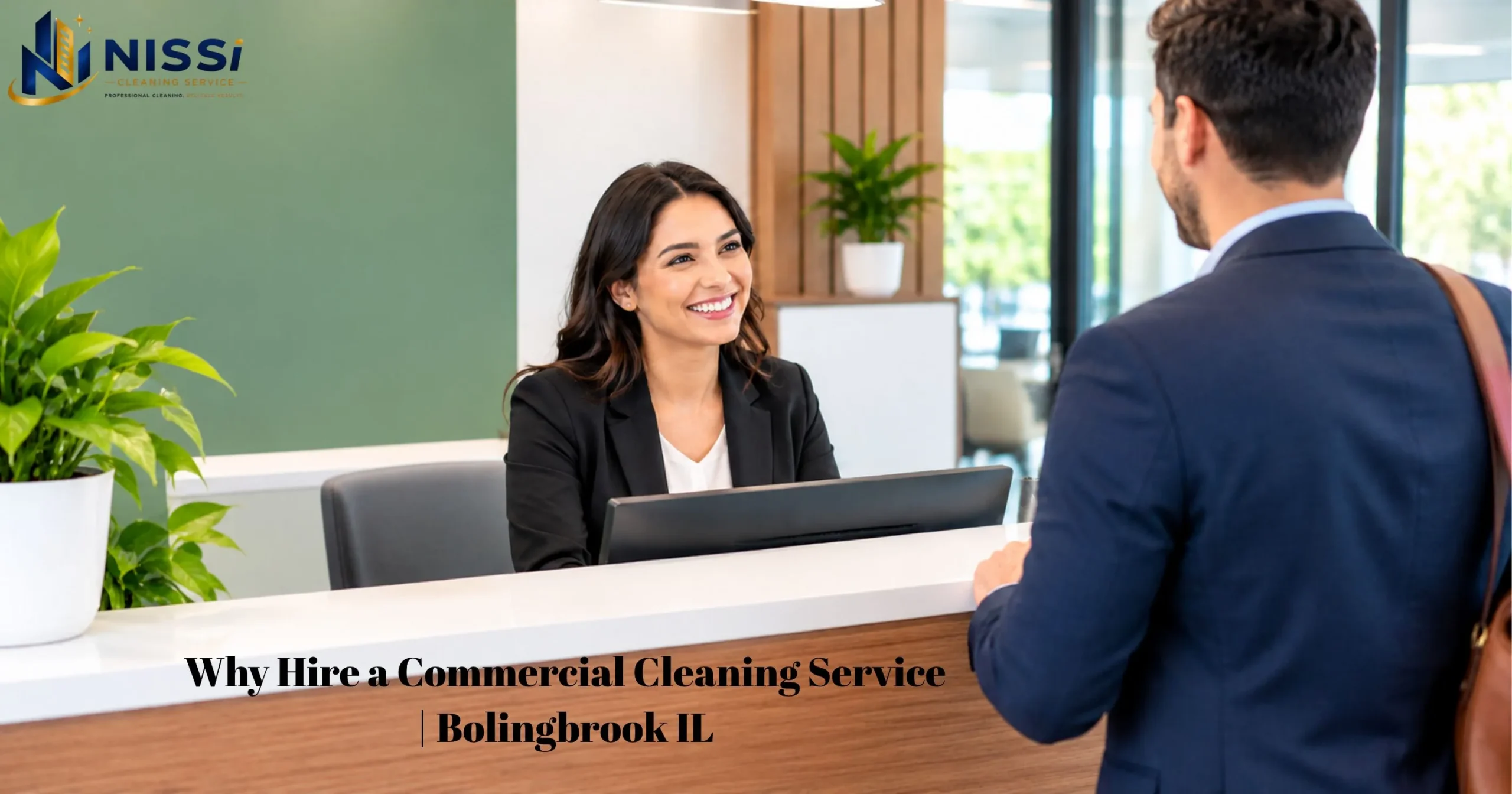
People judge your business before anyone says a word. A smudged glass door, an overflowing bin, a dusty reception desk, or a neglected restroom tells a visitor that details slip through the cracks here – and if you can’t manage your own space, why would they trust you with their work?
A consistently clean facility sends the opposite message: this is a company that pays attention. For client-facing spaces – medical offices, gyms, churches, schools, daycares – that first impression directly affects whether people choose you and whether they come back.
Germs spread fastest through the surfaces everyone touches: door handles, elevator buttons, shared keyboards, break-room counters, restroom fixtures. When those high-touch zones aren’t disinfected regularly, one sick employee becomes five.
Professional cleaners target exactly those areas with the right disinfectants, which lowers the spread of colds and flu and cuts down on unplanned absences. Fewer sick days means steadier output and a team that isn’t constantly covering for each other.
Clutter and mess are quiet drains on focus. Research into workplace environments has consistently found that people concentrate better and process information faster when their surroundings are clean and organized, rather than cluttered.
There’s a morale side, too. Walking into a spotless workspace every morning tells your team the company cares about their day-to-day comfort, and employees who feel valued tend to stay longer and work better.
Every person who walks into your building tracks in dust, pollen, and dirt that settles into carpet fibers and air ducts. Foot traffic then kicks those particles back into the air, where they circulate all day. In poorly maintained buildings, this contributes to headaches, fatigue, and respiratory irritation, sometimes called sick building syndrome.
Commercial cleaners use HEPA-filter vacuums and deep carpet extraction to pull those particles out instead of just moving them around, keeping the air your team breathes cleaner and the building more comfortable.
Handling cleaning internally looks cheaper until you add up everything it actually involves: wages, payroll taxes, benefits, cleaning equipment, ongoing supply purchases, and training. Equipment breaks and needs replacing. Supplies run out at the worst times.
With a commercial cleaning service, all of that rolls into one predictable cost. The company brings its own commercial-grade equipment and supplies, so there’s nothing for you to buy, store, or maintain, and you only pay for the hours and scope you actually need.
Cleaning a large commercial facility well takes more than a mop and a vacuum from the store. It takes floor machines, carpet extractors, auto-scrubbers, high-reach dusting tools, and the knowledge of which product and method is right for each surface, so tile, stone, hardwood, and carpet each get the care they need instead of being damaged by the wrong approach.
Trained crews also know the areas that are easy to miss and follow a consistent process, so you get a thorough, repeatable result rather than a different standard every week.
This is the benefit most business owners overlook. If an employee is injured while cleaning, slipping on a wet floor, or straining their back moving equipment, that can become your workers’ compensation claim and your liability.
A reputable commercial cleaning company carries its own liability insurance and workers’ compensation, so that exposure sits with them, not you. A professional provider is also more likely to stay current on health and safety standards (OSHA, EPA, CDC guidance), because compliance is their core business, not a side task for your staff.
When you evaluate a company, confirm they are fully insured and bonded. It protects your business if anything goes wrong on site.
Your needs aren’t fixed. A busy season may call for more frequent cleaning; a quieter stretch, less. You might add staff, extend hours, open another space, or finish a renovation that needs a one-time deep clean.
A commercial cleaning service can scale the schedule and scope up or down as those things shift. An in-house team with fixed hours usually can’t. And because cleaning can be scheduled around your operating hours, before opening, after closing, or on weekends, the work gets done without disrupting your staff, clients, students, or members.
Floors and furnishings are among the biggest physical investments in any facility, and dirt is abrasive. Grit ground into carpet and hard floors by daily foot traffic wears down fibers and finishes far faster than most owners realize. Spills left on upholstery set into permanent stains.
Scheduled professional care – carpet extraction, floor refinishing, and correct cleaning agents for each surface- removes the damaging buildup before it causes permanent harm. Spending a little on regular maintenance protects you from spending a lot on early replacement.
Some jobs fall outside the routine: post-construction cleanup, seasonal deep cleaning, floor stripping and waxing, high dusting, or a thorough reset before a big event or inspection.
Having an established relationship with a commercial cleaning company means you can add these services when you need them, without hunting for a separate vendor each time or buying specialized equipment you’d only use once a year.
The quickest way to see the difference is side by side:
Cost – Commercial cleaning service: one predictable invoice. In-house: wages, taxes, benefits, supplies, equipment.
Equipment and supplies- Commercial: provided by the company. In-house: you buy, store, and maintain it.
Scheduling – Commercial: flexible, around your hours. In-house: tied to one person’s shift.
Coverage when someone’s out – Commercial: guaranteed by the provider. In-house: your problem to solve.
Liability and insurance – Commercial: carried by the provider. In-house: your workers’ comp exposure.
Scaling up or down – Commercial: adjust scope anytime. In-house: requires hiring or cutting staff.
Specialized deep cleaning – Commercial: added as needed. In-house: needs equipment or another vendor.
Management overhead – Commercial: one point of contact. In-house: you hire, train, and supervise.
For most small and mid-sized businesses, outsourcing delivers consistent, professional results without the cost and headache of building a cleaning operation from scratch.
Commercial cleaning isn’t one-size-fits-all; the right program is built around how your facility is used:
Medical and dental offices- strict disinfection of high-touch and treatment areas to support patient trust and hygiene standards.
Offices – recurring janitorial work for workstations, conference rooms, restrooms, break rooms, and common areas.
Gyms and fitness centers – frequent sanitizing of equipment, locker rooms, and shared surfaces where germs spread fast.
Schools and daycares – safe, thorough cleaning of classrooms, restrooms, and high-traffic areas used by children.
Churches – cleaning scheduled around services, events, and community gatherings.
Warehouses – floor care, dust control, and upkeep of restrooms and break areas across large spaces.
Apartment common areas – lobbies, hallways, and shared amenities that shape how residents and prospects see the property.
Not every company is the right fit for your facility. Before you sign, ask:
Do you clean businesses like mine? Experience with your type of facility matters.
Are you fully insured and bonded? This protects your business if an accident happens on site.
What exactly is included, and how often? You want a clearly defined scope of work in writing.
Can you work around our business hours? Confirm evenings, weekends, or low-traffic scheduling.
Do you provide deep cleaning and floor care? Make sure they can handle periodic work, not just daily upkeep.
Who supplies the products and equipment? Clarify what’s included and what isn’t.
Can the schedule change as our needs change? Flexibility saves you from renegotiating later.
Will you walk through our facility first? A good provider assesses the space before quoting, instead of applying the same package to everyone.
The goal isn’t the cheapest quote – it’s a cleaning program that actually matches your building.
For nearly every business, yes. A commercial cleaning service pays for itself through fewer sick days, a stronger first impression, longer-lasting floors and furniture, reduced liability, and the hours your team gets back to focus on the work that grows the business. You’re not just paying someone to clean – you’re protecting your people, your assets, and your reputation.
Every figure above is a planning range based on published industry pricing data, not a quote. The most reliable way to get an exact number is a walkthrough or conversation about your specific space, square footage, restroom count, flooring, and how often you need service. Nissi Cleaning Service serves offices throughout Bolingbrook and the surrounding Will County area; Request a Free Quote.
Cost depends on the size of your facility, how often you need service, the type of business, and which tasks are included. The best way to get an accurate number is a walkthrough and a tailored quote rather than a flat rate, since a small office and a large warehouse have very different needs.
It depends on foot traffic and industry. High-traffic or health-sensitive spaces like medical offices, gyms, and daycares often need daily service, while smaller, lower-traffic offices may do well with two or three visits a week. Deep cleaning is usually scheduled separately.
Yes. Most commercial cleaning is scheduled before opening, after closing, or on weekends so the work doesn’t disrupt your staff, clients, or operations.
Janitorial services cover routine upkeep – vacuuming, trash, restrooms, dusting. Commercial cleaning is the broader category that also includes periodic deep work like carpet extraction, floor care, high dusting, and window cleaning. Many providers offer both.
Nissi Cleaning Service provides commercial cleaning for businesses across Bolingbrook and the surrounding area – medical and dental offices, gyms, churches, schools, daycares, offices, warehouses, and apartment common areas. We build each cleaning program around your facility, so you get consistent, professional results and a space that always makes the right impression.
Call (779) 212-4534 for a free quote and walkthrough.